Supreme Court Weighs Grace Period Restriction On Mail-In Voting

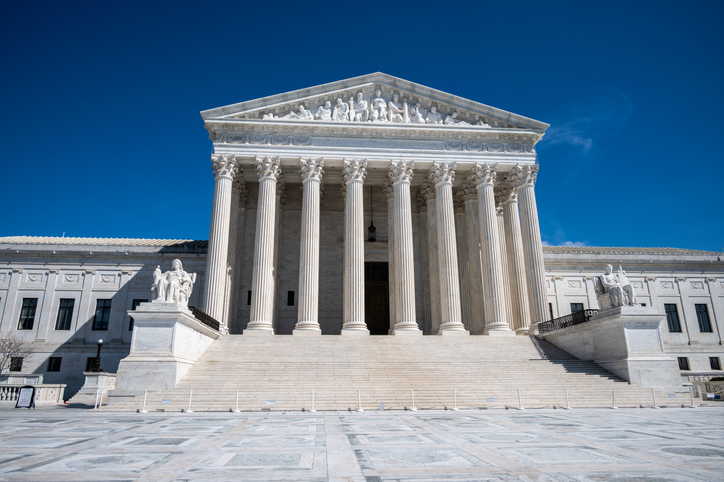
The Supreme Court is currently hearing a case brought by the Republican National Committee (RNC) that would eliminate grace periods for mail-in ballots received after Election Day. Should the Supreme Court rule in favor of eliminating the grace periods, which appears quite likely due to its 6-3 Republican supermajority, it could significantly impact mail-in voting ahead of the midterms this fall.
According to CBS News, the case, Watson v. RNC, focuses on a Mississippi law that allows mail-in ballots to be counted if they are postmarked by Election Day. The RNC argues that the grace period violates federal statutes that set Election Day as the Tuesday after the first Monday in November. “In the eyes of many, [grace periods] have hampered the efficiency and integrity of elections,” the RNC said during the hearing.
It should come as no surprise that Justices Samuel Alito and Clarence Thomas were among those most skeptical about the regulations allowing grace periods. Alito noted that voter confidence in elections “can be seriously undermined” if the outcome is “radically flipped” after late-arriving ballots are counted.
The New York Times reports that the court’s three liberal judges expressed support for the laws, with the main point being that federal law allows states to set their own election regulations. “Congress couldn’t have conceived of the kind of early voting we have now, it couldn’t have conceived of a thousand other ways in which we administer elections now,” Justice Elena Kagan said during the hearing.
As is usually the case with Republican endeavors, a ruling in the RNC’s favor could hurt those they claim to support. Take, for instance, troops deployed overseas. The grace periods allow troops to have their votes counted even if their ballots arrive after Election Day. Considering that the prospect of boots on the ground in Iran is appearing more and more likely, it’s incredibly on brand for the GOP to disenfranchise our troops while also forcing them to fight an entirely unnecessary war.
Since President Donald Trump took office last year, he and the GOP have been more focused on trying to steal the midterms than, you know, introducing policies that would help the average U.S. citizen. Trump’s first attempt to rig the midterms came through convincing states like Texas, Missouri, and North Carolina to engage in mid-decade redistricting efforts to gerrymander their Congressional maps. That effort was undermined when several Blue states began introducing redistricting efforts of their own, including California, which successfully passed a new Congressional map that neutralizes the gains map in Texas.
Trump then began a pressure campaign on the Republican-led Congress to pass the SAVE Act, which would require voters to show proof of citizenship when registering to vote. Should the act pass, it could effectively disenfranchise over 20 million U.S. citizens who don’t have immediate access to a passport or their birth certificate.
With the SAVE Act stalled in the Senate due to a lack of votes, Trump and the GOP are back to attacking mail-in voting. Trump made several false claims that he lost the 2020 election due to fraud committed via mail-in ballots. There has yet to be any evidence that widespread fraud has occurred due to mail-in voting, but that hasn’t stopped Trump and the GOP from trying to significantly restrict the option. More and more voters have elected to use mail-in ballots (myself included) in recent years because it’s convenient, and getting time off to go vote isn’t always easy.
The Supreme Court is expected to issue a decision on the case in late June or early July, only months before the midterms. Any ruling in the case would affect 13 other states with similar grace periods. So if you happen to be a mail-in voter, be sure to get your ballot out at least a week ahead of Election Day to ensure that your vote is counted, because it’s not looking good for grace periods.
SEE ALSO:
Supreme Court Allows Texas To Use Racially Gerrymandered Map
Supreme Court Blocks Trump From Deploying National Guard In Chicago
Supreme Court Weighs Grace Period Restriction On Mail-In Voting was originally published on newsone.com