Why There's Only One Iceman—and It’s Not Caleb Williams
There Is Only One Iceman—and It’s Not Caleb Williams

In 2012 there was a strange phenomena that was happening throughout Washington D.C. Gentrification was rampant, yet the city was using the core ethos of Black life to lure in white transplants while subsequently moving Black people out. Imagine a once all-Black city now having places like “Marvin’s” named after D.C. native Marvin Gaye or “Busboys and Poets” restaurant in reference to Langston Hughes’ trajectory from a busboy at the Wardman Hotel in Washington, D.C., to a world-renowned poet.
As the city began to whiten up, white people began venturing out beyond the four blocks from their homes that they were familiar with. As such, white people began discovering parts of the city and places that they never dared to venture before. They would share these places with each other as if they had just been built. I coined the moment, “Columbusing” and wrote a piece about it in the now-defunct TheRootDC.
The idea was this: Just because you’ve discovered something doesn’t mean it didn’t exist before you. And just because you’ve discovered it doesn’t mean that it’s yours.
This is a story about Caleb Williams.
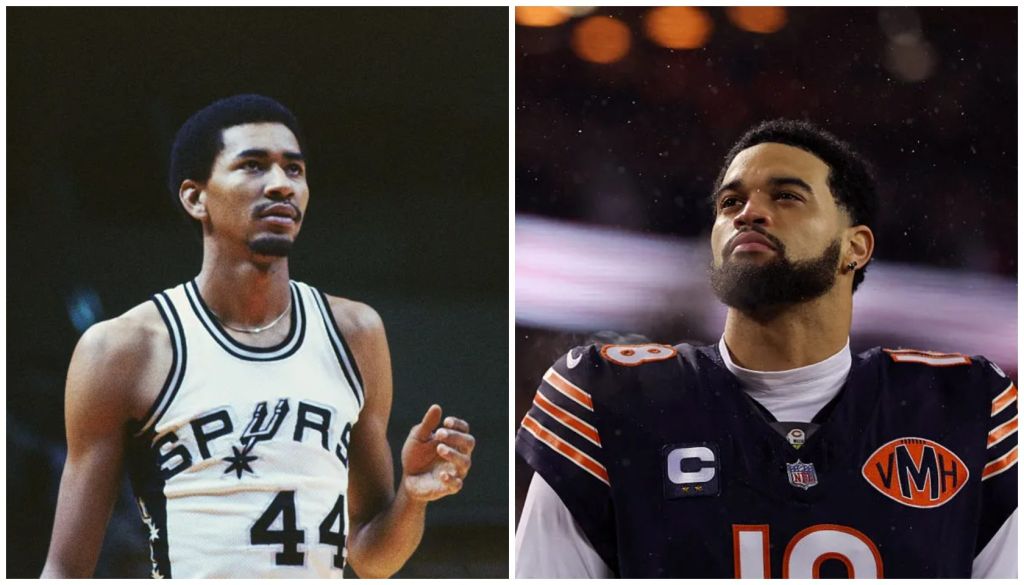
Caleb Williams entered the NFL with the subtlety of a marching band during a dinner party. He was brash, wearing painted nails and an inflated ego whose rookie-year talents didn’t measure up. His first season was a dud, but his attitude wasn’t reflective of that.
Back in 2024, former quarterback and MVP Cam Newton criticized the then-rookie Williams’ early struggles and suggested he needed to be humbled by the NFL, questioning his demeanor and leadership as a rookie. Instead of accepting the advice, Williams noted that he wasn’t concerned with outside opinions and was focused on improving and leading his team.
In his second season, Williams lived up to all the hype. He was a man amongst boys out there, and this playoff touchdown pass to send the game to overtime against the Los Angeles Rams will go down in Chicago Bears history.
While Williams proved himself to be cold, he’s no Iceman.
There’s a difference between confidence and audacity. And then there’s whatever Caleb Williams is doing by trying to trademark the nickname “Iceman.”
Because this isn’t just a savvy business move. It’s an embarrassingly tone-deaf attempt to monetize a legacy that already belongs—culturally, historically, and spiritually—to NBA legend George Gervin.
And the wildest part? This whole mess is only possible because nobody bothered to legally protect something everyone already knew was taken.
Let’s start with the obvious: Gervin is the Iceman. Not “an” Iceman. Not “a previous version.” The Iceman. The nickname dates back to the 1970s, when Gervin’s smooth scoring and unbothered demeanor made him one of basketball’s most iconic figures, eventually earning him Hall of Fame status and four scoring titles.
For more than 40 years, the name has been synonymous with him. That’s not branding—that’s cultural ownership. Which is why Gervin himself was caught off guard when Williams filed to trademark it, saying he never imagined someone would even try.
And that reaction says everything.
Because this isn’t about legality, it’s about respect. Williams earned the nickname “Iceman” during the 2025 NFL season for his late-game composure. Fair enough. Athletes get nicknames all the time. But there’s a difference between having a nickname and trying to own it—especially when that name is already etched into sports history.
That’s where this crosses from harmless to ridiculous. Nicknames like “Iceman” aren’t just catchy phrases—they’re part of the mythology of sports. They’re given by fans, shaped by moments, and cemented over decades. They don’t belong to marketing teams or LLCs. As one critique put it, they’re “gifts,” not commodities to be claimed.
And yet, here comes Williams, filing not one but multiple trademark applications tied to the name for merchandise and branding purposes. That’s not homage. That’s a land grab.
Now, to be clear: Williams isn’t breaking the law. In fact, he might even win.
Because here’s the part that should make everyone uncomfortable: “Iceman” was still available to be trademarked. Despite decades of use, Gervin never formally locked it down through the U.S. Patent and Trademark Office. So when Williams filed first in March 2026, he potentially gained the upper hand in a system that prioritizes paperwork over legacy.
Gervin and his team only filed their own applications days later, scrambling to protect something that, culturally, was never in doubt. That’s how you end up in a situation where a 24-year-old quarterback could legally claim ownership over a nickname built by a Hall of Famer before he was born.
If that doesn’t feel broken, it’s because we’ve gotten too comfortable confusing legality with legitimacy.
And that’s really the core issue here.
Williams’ defenders will argue this is just business. That Gervin should’ve trademarked it earlier. That “if it’s available, it’s fair game.” But that argument only works if you ignore the unwritten rules that have always governed sports culture: respect the people who came before you.
You don’t see players trying to trademark “Air Jordan.” You don’t see someone filing paperwork to own “Showtime” or “Broadway Joe.” Not because they legally can’t—but because they understand those names mean something bigger than profit.
Williams, at least in this moment, doesn’t seem to get that.
And maybe that’s the most telling part of the backlash. It’s not just about Gervin—it’s about what happens when modern athletes treat history like unused intellectual property instead of something to honor.
Even the public reaction reflects that divide. Critics—from media figures to fans—have called the move disrespectful, while others have shrugged it off as smart business, even admitting they didn’t know who Gervin was in the first place.
That ignorance is the problem.
But that’s exactly why it matters.
Skip Bayless, who is the broken clock of sports hot takes, found the right time recently when he blasted Williams for trying to steal the “Iceman” nickname.
Williams responded to Bayless rather smugly.
Sports don’t exist in a vacuum. Every touchdown, every highlight, every nickname sits on top of decades of players who built the stage. And when you ignore that lineage, you’re not just being opportunistic—you’re being dismissive. Williams has every right to build his brand. He’s a star, and stars should capitalize on their moment.
But not like this.
Not by trying to trademark a name that already belongs to someone else in the only way that really counts.
Even if Williams wins the paperwork battle—he’ll still lose the cultural one.
And no amount of trademarks can fix that.
There Is Only One Iceman—and It’s Not Caleb Williams was originally published on cassiuslife.com